Adaptive occupational heat safety

Stop scheduling heat safety by the calendar.

HeatGuard reads the on-site heat-stress conditions and gives the supervisor one clear instruction each hour β€” replacing the Gulf's blunt midday work-ban with a responsive, standards-based system that also proves workers were protected.

WORK REST IN SHADE DRINK NOW STOP
Live signal Β· Dubai Β· 08:00WBGT 26.4 Β°C
Acclimatized worker Β· moderate
WORK
Work / Rest60 min Β· 0 min
Hydration2.0 cups / h
Max continuous364 min
WORK REST IN SHADE DRINK NOW STOP
0
migrant workers in the Arab States β€” 41.4%, the highest share of any world region
50 Β°C+
Gulf summers, with WBGT routinely past the limits of human thermoregulation
0
migrant deaths per year (all-cause); >50% certified with no underlying cause
1 of 19
migrant-worker heat studies worldwide came from the Gulf β€” a near-total evidence void

The danger & the scale

A heat crisis hidden behind a blunt clock

Millions of people do heavy outdoor labour where the heat now exceeds what a human body can shed. The only widespread control is a fixed calendar ban β€” and it is wrong in both directions.

24M

Workers in harm's way

Migrant workers across the Arab States β€” the highest migrant-worker share of any region on Earth (41.4%).

~10,000/yr

Deaths, cause hidden

All-cause migrant deaths per year. Over half are certified with no underlying cause β€” so heat-attributable mortality stays invisible.

1 of 19

An evidence void

Only one of nineteen migrant-worker heat studies worldwide came from the Gulf. The danger is unmeasured where it's worst.

TOO PERMISSIVE It misses real danger

  • Starts too late β€” extreme heat now arrives in May, before any ban is in force.
  • Misses humid mornings & evenings outside the noon window β€” WBGT can be lethal at 9 a.m.
  • Ignores the worker β€” an unacclimatized newcomer gets the same protection as a veteran.

TOO RESTRICTIVE It stops safe work

  • A cool, breezy noon is banned even when conditions are genuinely workable.
  • It needlessly destroys safe, productive hours β€” which is why employers resent and evade it.
  • A fixed rule can't be both safe and efficient: the risk isn't fixed (e.g. Saudi 12:00–15:00, 15 Jun–15 Sep).

The solution

Sense the conditions. Schedule the work. Prove it happened.

A site-level, WBGT-driven work–rest–hydration scheduler for the supervisor β€” not a wearable. One sensor per site, near-zero cost per worker, riding on infrastructure crews already have.

🌑️
01 Β· Sense

Read the real heat

Estimate WBGT from weather, or take one on-site reading from a ~$300 meter β€” per ISO 7243.

πŸ“‹
02 Β· Schedule

The actual cycle

Outputs the real ACGIH/ISO 7243 work-rest cycle + ISO 7933 hydration target for these conditions and this job.

πŸ“£
03 Β· Signal

One clear order

Broadcasts a single signal everyone understands: WORK Β· REST IN SHADE Β· DRINK NOW Β· STOP. Plus a NIOSH ramp for new arrivals.

πŸ”’
04 Β· Verify

Provable record

Logs every decision to a tamper-evident, hash-chained, privacy-by-design worker-protection record β€” a compliance shield.

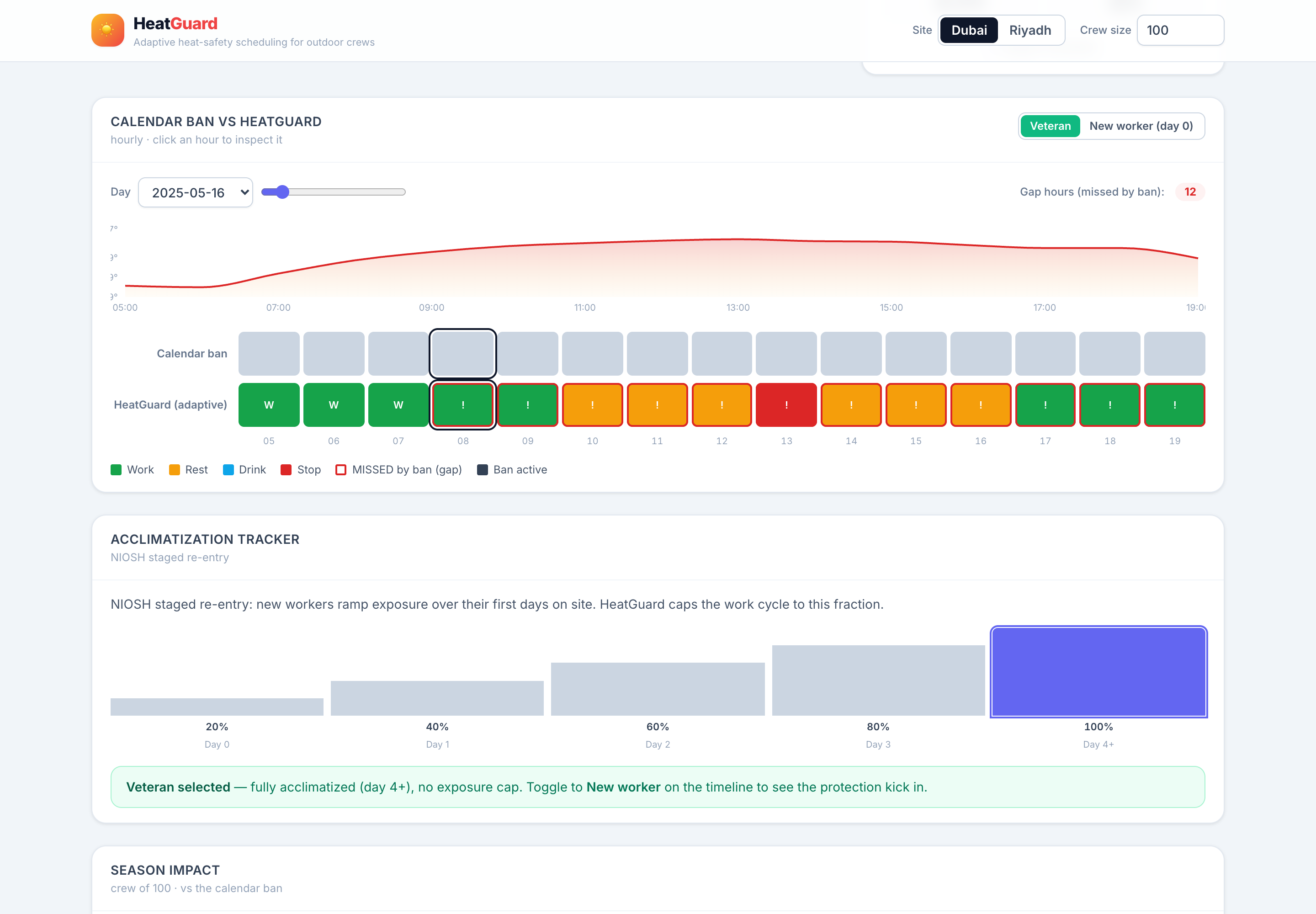
HeatGuard timeline: the fixed calendar ban (grey) versus HeatGuard's hour-by-hour adaptive signal (green WORK, amber REST, red STOP), showing the gap hours the ban missed.
Calendar ban vs HeatGuard. The grey ban window is blind to conditions; HeatGuard's coloured row schedules each hour to the real WBGT and the worker β€” catching the danger hours the ban misses.
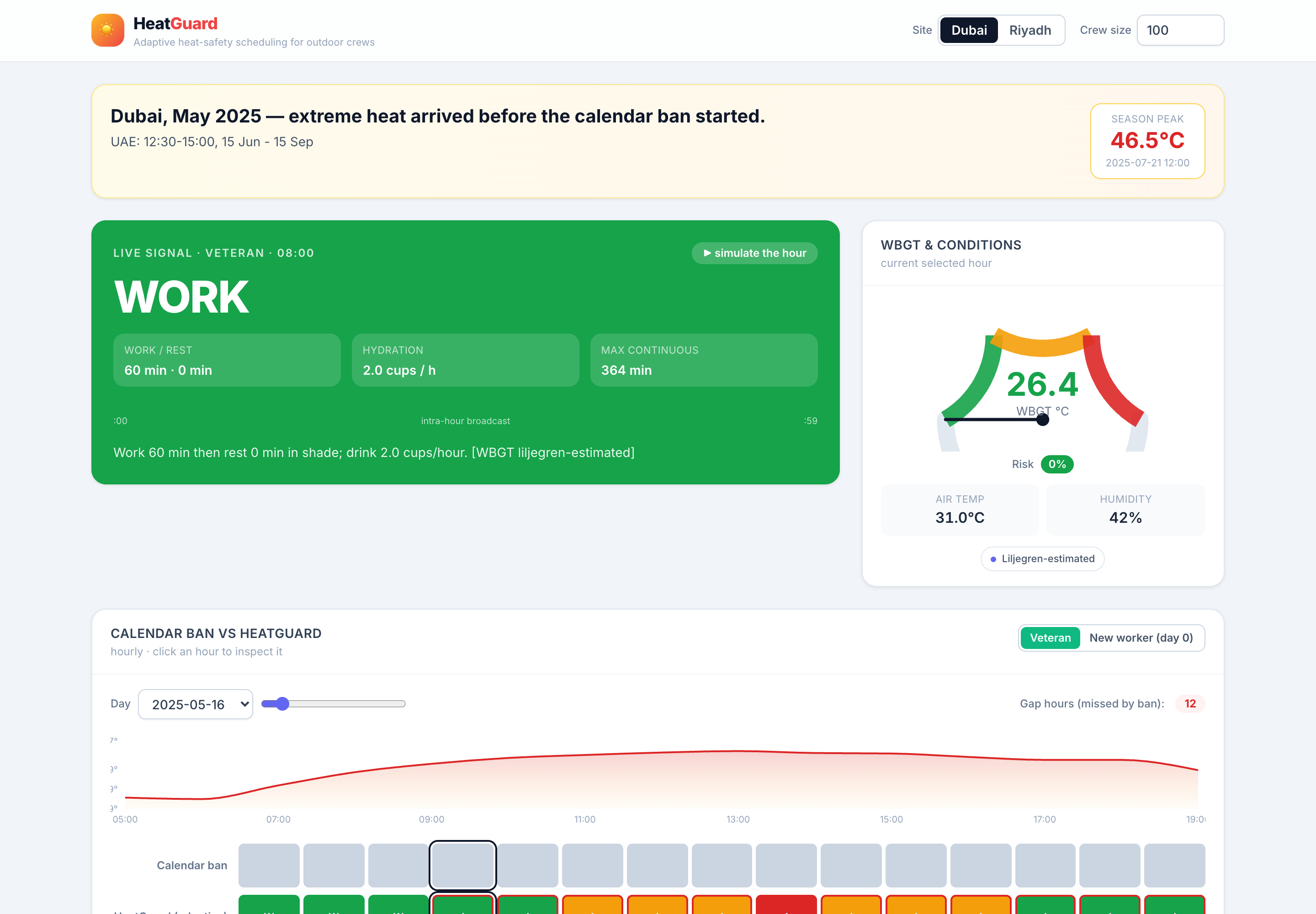
HeatGuard dashboard: a green WORK signal tile with work/rest cycle and hydration, beside a WBGT gauge reading 26.4 with air temperature and humidity.
The live signal + WBGT gauge. Dubai, May 2025 β€” extreme heat arrived before the calendar ban even started.
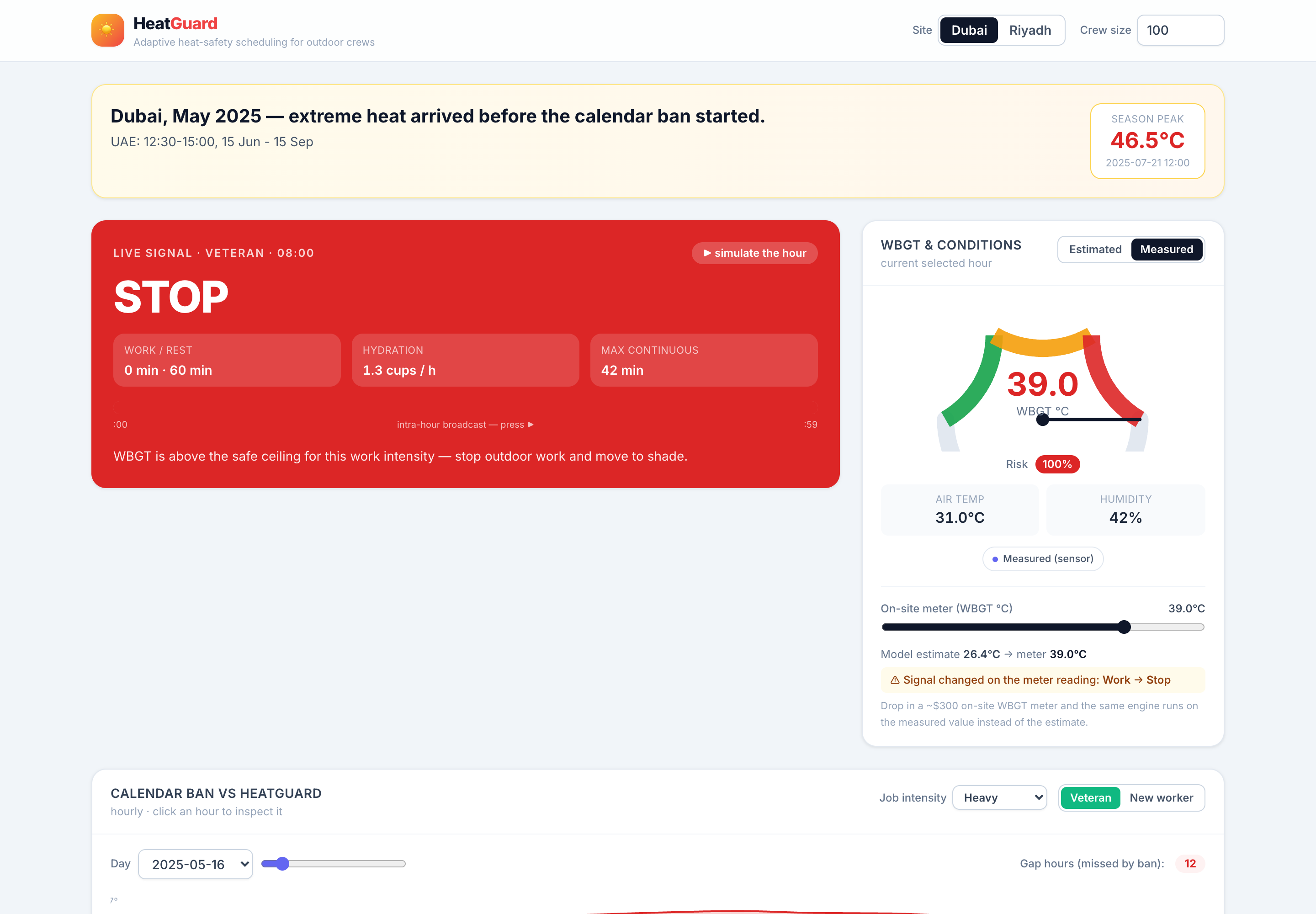
HeatGuard dashboard with the Estimated to Measured toggle, showing an on-site meter reading driving the same engine.
Estimated ⟷ Measured. Swap in a real on-site meter reading and watch the same engine recompute the signal β€” the approximation is never hidden.

Impact

The headline isn't dollars. It's people.

Modelled on a real intervention (La Isla / Adelante, Nicaragua): acute kidney injury down ~94%, productivity up 10–20%. Below: a regional slice of the Dubai season β€” illustrative, conservative.

Lives saved (regional slice)
~0
across a 5,000,000-worker regional slice for one Dubai season β€” illustrative / conservative.
Kidney-injury (AKI) cases averted
~0
acute kidney injuries prevented across the same regional slice β€” the disease this hidden epidemic is built on.

Per 100-worker crew Β· one Dubai season

The verifiable unit the whole model scales from.
0
danger-hours the ban missed
7.7
AKI cases averted vs ban
3.3–5.3Γ—
return on investment
0
day payback
+10–20%
productivity maintained / raised
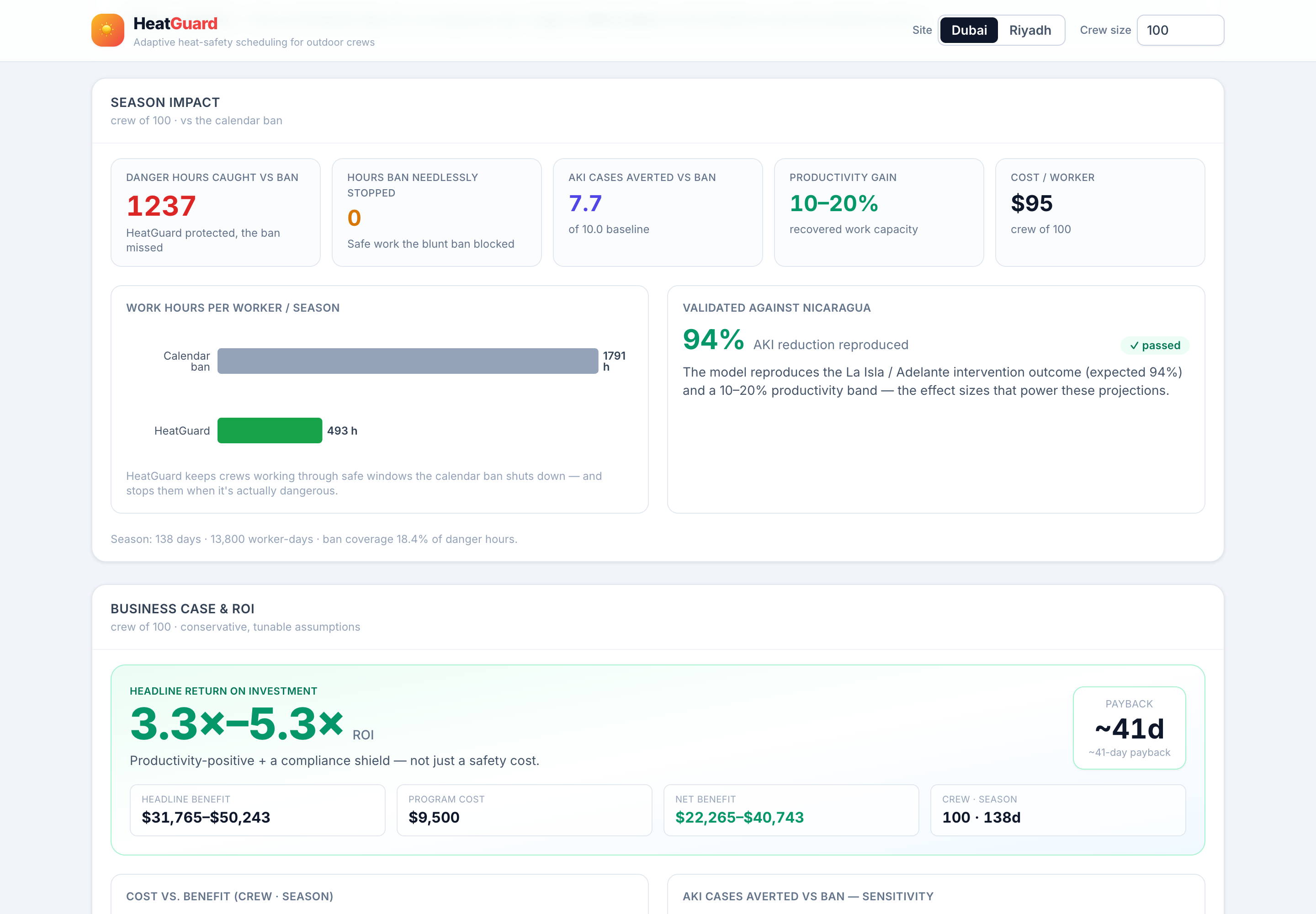
HeatGuard season impact and ROI panel: danger-hours protected, AKI cases averted, and the business case with an AKI sensitivity range.
Season impact & the business case, computed from real Open-Meteo weather β€” with the uncertain baseline shown as a sensitivity range, not a single point.

Impact at scale (Dubai season, illustrative / conservative)

~2
lives saved
384
AKI cases averted
6.2M
danger-hours protected
$1.6–2.5M
value created
~38
lives saved
7,670
AKI cases averted
124M
danger-hours protected
$32–50M
value created
~1,900
lives saved
~383,500
AKI cases averted
β€”
danger-hours protected
$1.6–2.5B
value created

Scale figures are illustrative and conservative, extrapolated from the per-crew model on real weather. The per-100-crew unit and the Nicaragua back-test are the verifiable backbone. See exactly how every number on this page is calculated β†’


The business case

Not a safety cost. A productivity gain with a 6-week payback.

The headline benefit deliberately excludes the lives-saved and turnover terms, so it can't be accused of inflation β€” and it still pays for itself fast, plus a compliance shield against fines.

Productivity value Recovered safe work AKI value Fines avoided
3.3–5.3Γ—
  • ~41 dayspayback on a Dubai crew of 100
  • ~$95program cost per worker, per season
  • +10–20%productivity maintained or raised, despite breaks

The deadliest group

Newcomers die first. HeatGuard ramps them in safely.

A newly-arrived, unacclimatized worker is the group that actually dies β€” and the cheapest to protect, because it is pure scheduling. HeatGuard applies the NIOSH graded re-entry ramp and screens against the stricter Action-Limit table while a new worker acclimatizes, then relaxes as they adapt.

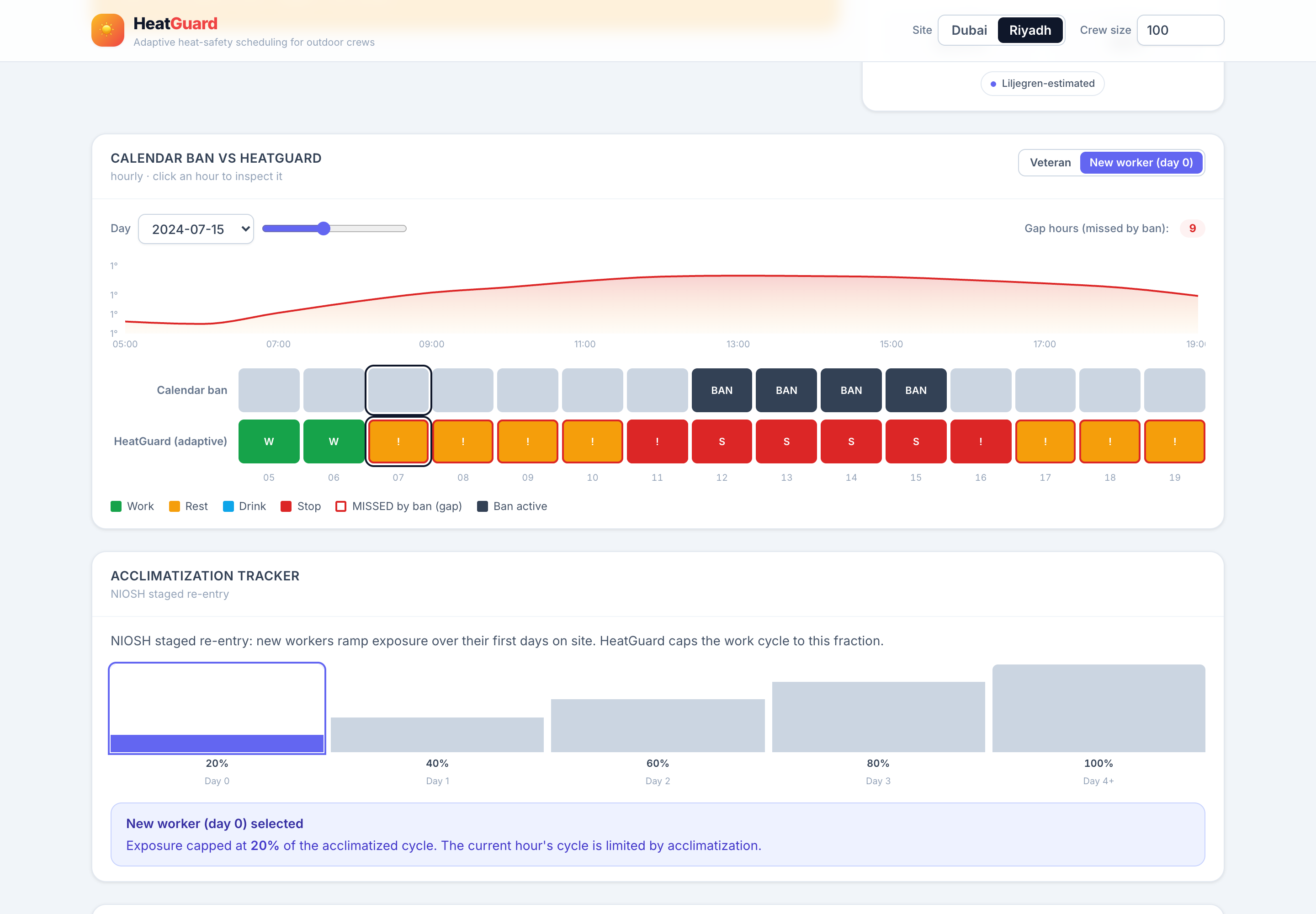
HeatGuard with a new-worker (day 0) selected: the acclimatization tracker caps the work cycle and the timeline tightens to protect the unacclimatized newcomer.
New worker, day 0. The acclimatization tracker caps exposure and the schedule tightens β€” protection the calendar ban can't give an individual.

Evidence-based

Standards-based, back-tested, and honest about its limits.

βœ“ Built on published standards

ISO 7243, ISO 7933, ACGIH and NIOSH β€” WBGT via the validated Liljegren model. Nothing invented; the science is the cheap, proven part.

βœ“ Reproduces a real intervention

The impact model reproduces the La Isla / Adelante (Nicaragua) outcome β€” AKI βˆ’94%, productivity +10–20% β€” as a back-test that fails loudly if anyone changes an effect size.

βœ“ Tested & green CI

79 automated tests with green continuous integration cover the table values, WBGT sanity, the scheduler logic, the hash chain, and the economics.

ISO 7243 ISO 7933 PHS ACGIH TLV / Action Limit NIOSH ramp Liljegren WBGT 79 tests Β· green CI

Honest about limits

WBGT estimate vs on-site meter; effect-size transfer from Nicaragua agriculture to Gulf construction carries uncertainty; the cost/value assumptions are illustrative and deliberately conservative. The genuinely hard problem is adoption β€” which is why HeatGuard leads with productivity and the compliance shield.


How it works

One deterministic engine, five interfaces.

Weather in, a provable schedule out β€” computed in exactly one place.

INPUT

Open-Meteo weather

Free historical archive + forecast; cached for an offline demo.

β†’
SENSE

Liljegren WBGT

Validated outdoor heat-stress index, with a Stull night fallback.

β†’
SCHEDULE

ACGIH + ISO 7933

Work-rest cycle + PHS hydration target for these conditions.

β†’
OUTPUT

Signal + hashed log

One broadcast signal and a hash-chained, tamper-evident record.

Python engine FastAPI React Streamlit

Stop scheduling heat safety by the calendar.

See the live dashboard run real Gulf weather through the engine β€” the signal, the timeline, the impact, and the ROI.